sunset

sunset
wicken fen
Showing posts with label photo. Show all posts

Friday, 22 March 2013

Why I shoot 'raw'


Why do I choose to shoot 'raw'?

lets start things of with what 'raw' means. 'raw' is an image that has been taken directly from the sensor to a memory storage device. The 'raw' image has not been edited by the camera. A 'raw' file has also had meta data attached to it. this data will include things such as shutter speed, aperture, focal length, lens model, camera model and many more.

With a 'raw' file you get a lot more flexibility with your image. You can control allot of things in post processing. these things vary depending on your software. I use canons own photo editing software DPP. In this software you can control things like exposure compensation, white balance, colour tone weather you want more shadows or brighter highlights, clipping the whites or the blacks, sharpness and many others

This control can be the difference between getting the shot you want or having to press the delete button and missing the moment.

If you choose to shoot in a 'raw' format you must first check you have suitable software to edit the file and convert into different formats.

As with nearly anything it is down to personal preference what format you choose to use as there are pro's and cons with both JPEG an 'raw' formats

PRO'S

JPEG 
  • instant capture of a moment with out the need to edit to upload to the net or to print
  • great for memory shoots (point and shoot)
  • smaller file size (could also be seen as con)


'raw'  
  • more post processing power
  • larger file size (could also be seen as a con)
  • more artistic flare can be implemented
  • more stored meta data
CONS

JPEG
  • less control over post processing
  • smaller file size (again maybe seen as a pro)
'raw'
  • limited software that can read and edit 'raw' files
  • more time in post processing
  • not able to print or share via the web instantly
  • not all camera models can shoot 'raw'
  • a number of different 'raw' formats used
  • large file size (again could be seen as a pro)

Monday, 22 October 2012

Fundamentals of Photography

In my eyes there are 3 main things you have to think about to get the right exposure.
  1. Shutter Speed
  2. Aperture
  3. ISO
The first thing to know is that if you get one of these things wrong your exposure may not have the wow factor.

A photo is in essence a capture of light. Your camera measures lights in "stops".

Shutter Speed

Shutter speed is the time the curtain in front of the sensor is open for. This is measured in seconds. on my 'canon 550d' I can set it the shutter speed from 1/4000second (fastest) to 30seconds. there is also 'BULB' mode which is there for a custom shutter speed for anything from 1second to as long as the power supply lasts.

The preset times for the shutter speed are set to change the 'stops' by 1/3 increments, for example if you set the shutter speed to 1/200sec and change it to 1/250sec it will darken the exposure by 1/3 of a stop. If you were to change it to 1/160se it will lighten your exposure by 1/3 of a stop.

Aperture
Aperture is measured in F'stops'. In my eyes it is very tricky to get a grasp of. This is because the smaller the 'F' number is the larger the aperture opening is for example my 'canon 18-55mm' lens set at 18mm is wide open at 'F'3.5 and is at its smallest at 'F'22

Now let me try to explain how the aperture effects the exposure. the first thing to remember is that the smaller the 'F' number the more light can get to the sensor when you take an exposure. this means you will be able to use a faster shutter speed or a lower 'ISO' (more about that later). A side-affect of this is something called 'Depth of Field' or 'DoF' this is used to bring only certain things into focus. For example a photo of a flower taken at 'F'3.5 will have a blown out background whereas a the same flower taken at 'F'11 will have a lot more in focus.
'F'3.5      aperture example        'F'11

As I stated for the shutter speed, the preset aperture settings are set to change the 'stops' of light by 1/3 increments for example if you set the aperture to 'F'7.1 and change it to 'F'6.3 it will lighten the exposure by 1/3 of a 'stop', if you were to change it 'F'8 it will darken the exposure by 1/3 of a 'stop'

ISO
ISO is the setting that you use to determine how sensitive the sensor in your camera is. my 'canon 550D' has a range from ISO100 to ISO6400

The ISO sensitivity doubles in size so the 550D goes from ISO 100, 200, 400, 800, 1600, 3200, 6400 each jump equals to 1'stop'. For example if you set your ISO to 200 and then change it to 400 your exposure will be 1'stop' brighter, if you were to change it to 100 it would become 1'stop darker

When the ISO is bumped up it has an effect on your photo by showing noise in the photo.

Choosing your ISO depends on what you are shooting and what for. for example if you are shooting to get a pin point perfect exposure you need to pick the lowest ISO possible, if you are capturing a memory than the grain/noise in a photo may not matter so much.

Shutter speed + Aperture + ISO =
When you add all of this together and get it all correct you should get a perfectly exposed photo. Saying this that doesnt mean it the best exposure to suit you and the subject. after time you will find your own style of photography. Here are examples of how just changing one of the 3 settings change the exposure


ISO1600, Aperture5.6, Shutter speed 1/15second
Under exposed -2stops


ISO1600, Aperture5.6, Shutter speed 1/4second
Correct exposure 0+/-
ISO1600, Aperture5.6, Shutter speed 1second
Over exposed +2stops

Saturday, 20 October 2012

Light Photography

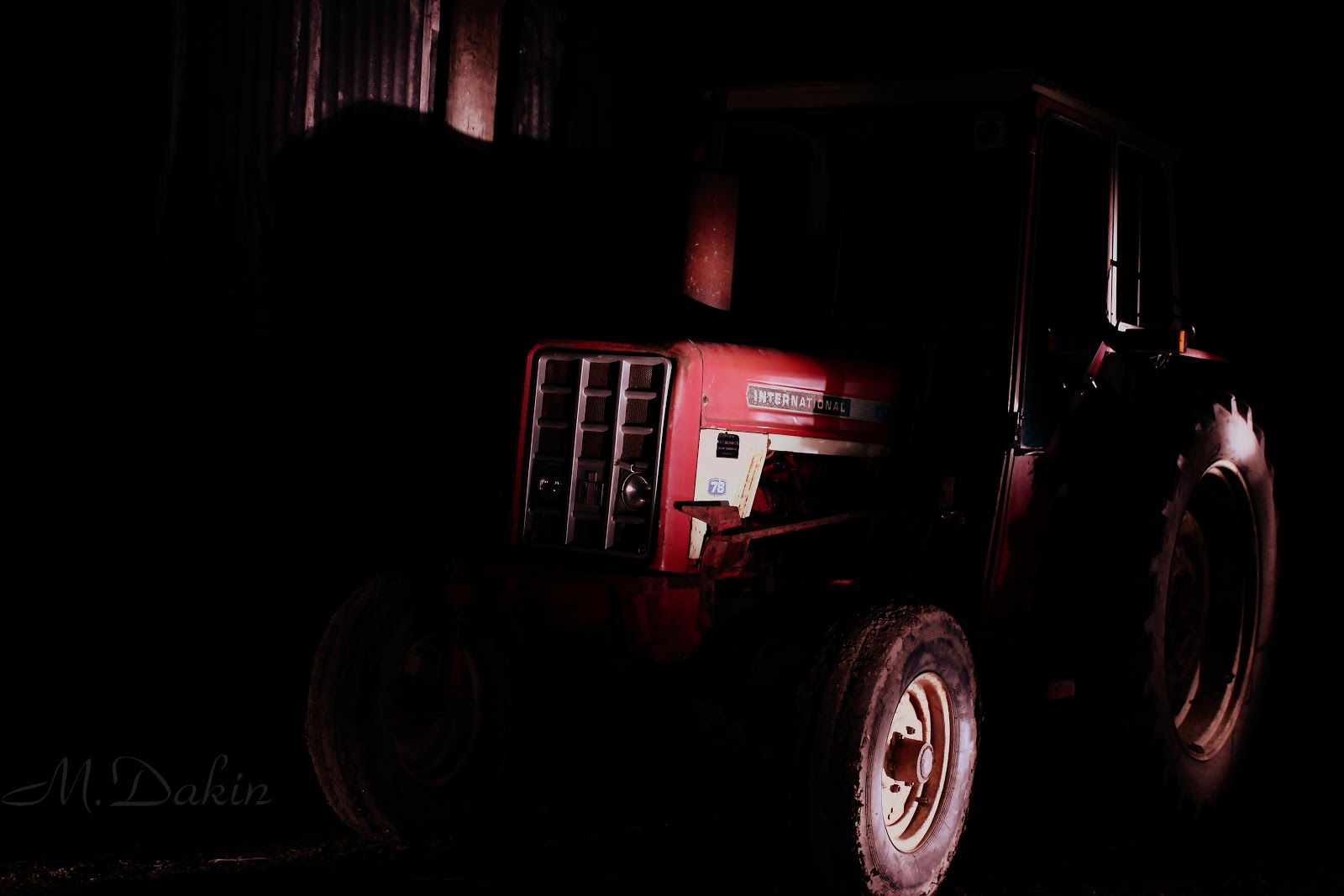
Here are some of photos manipulating the use of light

light orb

light without power

ring of sparks

life in the dark

shady tractor

the power of heat

burning under stress

spiro-LIGHT-graph

star gate

follow the laser
One of my favorite things to play with is light manipulation. To for this you need a sturdy tripod, a shutter release cable and a lot of time and patience.

Some of the sbove images have an exposure time of over 7minutes, others as short as 1/1000second  

Thursday, 18 October 2012

new photograpghy blog

Hello.
I am an amature photographer wanting to share my work with the world.

Over the next few posts I will be sharing some of the knowledge I have gathered and put together.
I will also be posting some of my favorite images.